
Table of Contents (18 sections)Show ↓
Every digital marketing executive managing organic visibility eventually confronts the same foundational question: what is a meta title, and why does this single HTML element carry disproportionate weight in click-through rate performance across the entire SERP landscape. Agencies analyze thousands of ranking positions where technically superior content underperforms because the title tag fails to trigger cognitive relevance at the moment a user scans results.
This analysis breaks down the exact mechanics search engines use to parse, render, and reward title tags, the pixel-width thresholds governing visibility, and the psychological triggers that convert impressions into clicks. Executives who master this layer gain a lever that content quality alone cannot replicate.

The Architecture Behind Every Search Click Decision
Defining the Meta Title Within Search Engine Architecture.
The Technical Definition
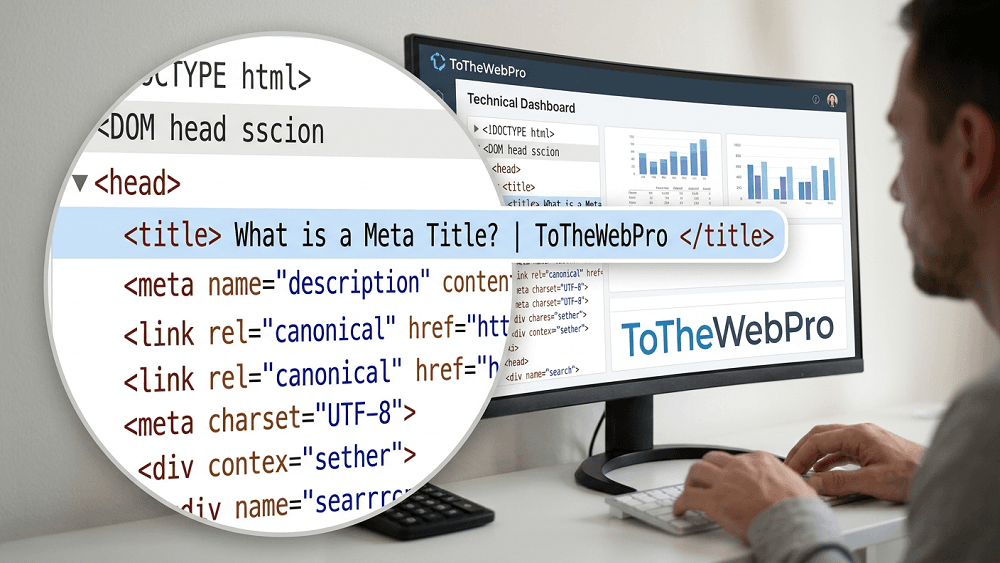
The HTML title element represents the primary anchor text that search engines extract, parse, and display within organic search results. Search engines read this specific tag directly from the head section of the document object model. Google frequently rewrites this string algorithmically when the existing text fails to align with the query intent driving a search session.
Why Search Engines Rewrite Title Tags
Google's algorithm evaluates title relevance against query context in real time. When a title tag reads as generic, keyword-stuffed, or misaligned with on-page content, the algorithm substitutes an alternative pulled from header tags or body copy. This rewriting behavior signals a critical truth: search engines optimize for user satisfaction first, and webmaster-specified titles only survive algorithmic scrutiny when they already satisfy that standard.
Check Your Meta Title Before Google Does
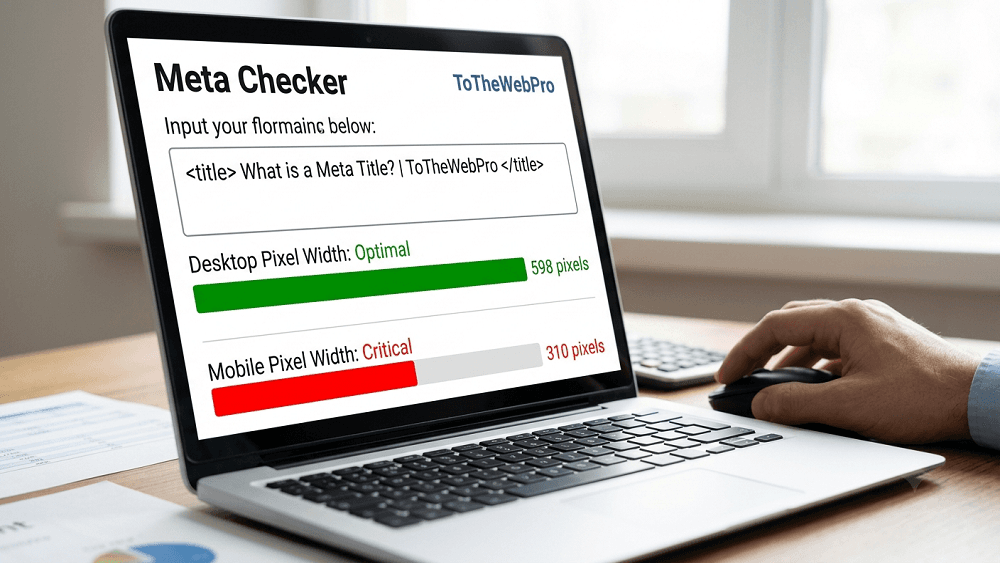
A well-written meta title can significantly improve your click-through rate, but only if it meets search engine best practices. Use ToTheWebPro's Meta Checker to instantly analyze your title length, pixel width, keyword placement, and optimization score. Identify truncation issues, improve relevance, and create titles that attract more clicks from search results.
Pixel-Width Thresholds and Truncation Mechanics
The Pixel Limit Reality
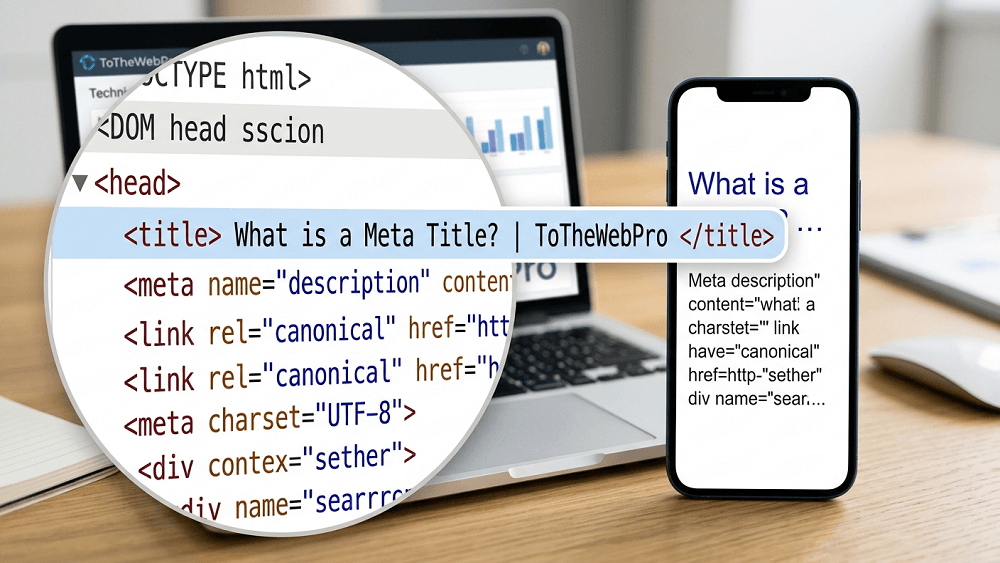
Character counts alone never determine title truncation. Google renders titles within a fixed pixel-width container, typically around 600 pixels on desktop and narrower on mobile devices. Wide characters like W and M consume significantly more pixel space than narrow characters like i or l, meaning two titles with identical character counts can render completely differently.
Strategic Pixel Allocation
Skilled SEO consultants front-load primary keywords and brand-relevant terms within the first 60 pixels of the title, since search engines weight early-positioned terms more heavily during relevance matching. Executives should audit titles using pixel-measurement tools rather than relying on character-count estimates alone, since character-based approximations consistently produce inaccurate truncation predictions.
User Intent Alignment as a Ranking Signal
Matching Title Language to Search Intent
Search engines increasingly reward titles that mirror the linguistic patterns users employ when expressing informational, navigational, transactional, or commercial investigation intent. A title built around generic descriptors fails to trigger the recognition response that intent-matched language produces instantly within a searcher's cognitive scan path.
Semantic Entity Recognition
Modern search algorithms parse titles for semantic entities, recognizable concepts, brands, and topics that connect to the knowledge graph. Titles that include clearly identifiable entities help search engines disambiguate query context faster, improving both ranking probability and the algorithm's confidence in serving that result for entity-specific queries.
Cognitive Relevance Triggers and Click Psychology
The Three-Second Scan Window
Users scan SERP listings within an extremely narrow attention window before deciding which result deserves a click. Titles that front-load specificity, numbers, or direct answers to implied questions outperform vague titles because they reduce the cognitive load required to assess relevance.
Curiosity Gaps Versus Clickbait Penalties
Effective titles create legitimate curiosity gaps, prompting clicks through genuine information asymmetry rather than manipulative exaggeration. Google's algorithm tracks post-click engagement signals, and titles that overpromise relative to page content generate pogo-sticking behavior that search engines interpret as a relevance failure, ultimately suppressing rankings despite any short-term CTR gain.
Algorithmic CTR Manipulation and Ranking Feedback Loops
CTR as an Indirect Ranking Signal
While Google denies using raw CTR as a direct ranking factor, observed click behavior feeds machine learning systems that refine result ordering over time. Titles generating consistently higher CTR relative to their ranking position send positive engagement signals that influence long-term visibility trends.
Testing and Iteration Frameworks
Enterprise SEO teams should treat meta titles as testable assets, running structured experiments across title variations and measuring CTR shifts within Google Search Console. This data-driven iteration cycle consistently outperforms static, set-once title strategies across competitive keyword clusters.
Enterprise Content Synchronization across CMS Frameworks
Modern content management systems automate meta title generation through programmatic templates, often combining the primary H1 header with a static brand suffix. While this system offers scaling efficiency for thousands of e-commerce category pages, it frequently dilutes keyword proximity and ignores structural pixel limits. Marketing directors must implement hard validation overrides within their deployment pipelines, ensuring that manual optimization takes precedence over automated strings on high-value conversion pages. Customizing these assets ensures absolute alignment with target keywords and prevents algorithmic truncation across high-volume terms.
Conclusion
The meta title functions as the primary interface between algorithmic relevance scoring and human click psychology, meaning that HTML-level optimization decisions directly govern organic CTR performance independent of underlying content quality. Executives who treat title tags as a continuously optimized asset, calibrated against pixel-width constraints, intent alignment, and semantic entity recognition, consistently outperform competitors who treat this element as a one-time technical formality.